What Can Be Custom-Built in Your Boulder Outdoor Space?

Boulder homeowners spend a lot of time outside. The climate — over 300 days of sunshine annually, mild shoulder seasons, and mountain views that reward an outward-facing design — makes outdoor living less of an amenity and more of an expectation. But the same environment that makes outdoor space so desirable also makes it technically demanding to build in. Freeze-thaw cycling, expansive soils, intense UV, and Front Range wind loads mean that what gets built in a Boulder backyard needs to be engineered for this place, not simply installed from a catalog.
Custom outdoor builds in Boulder span a wide range — from grade-correcting retaining walls and natural stone patios to covered pergola structures, fire features, water elements, and full outdoor kitchens. Each has its own design logic, material requirements, and construction standards. This post walks through the primary categories of custom outdoor construction, what each involves at a technical level, and how they combine to create outdoor spaces that perform as well as they look.
What Custom Hardscape Options Work Best in Boulder's Climate?
Hardscape — the non-planted, structural elements of an outdoor space — is the foundation on which everything else is built, both literally and compositionally. In Boulder County, hardscape design must account for the region's 150-plus annual freeze-thaw cycles, which exert significant stress on any material set in the ground or in a mortar bed. Material selection, base course preparation, and drainage integration are the three variables that determine whether a hardscape installation holds up over decades or begins to fail within a few seasons.
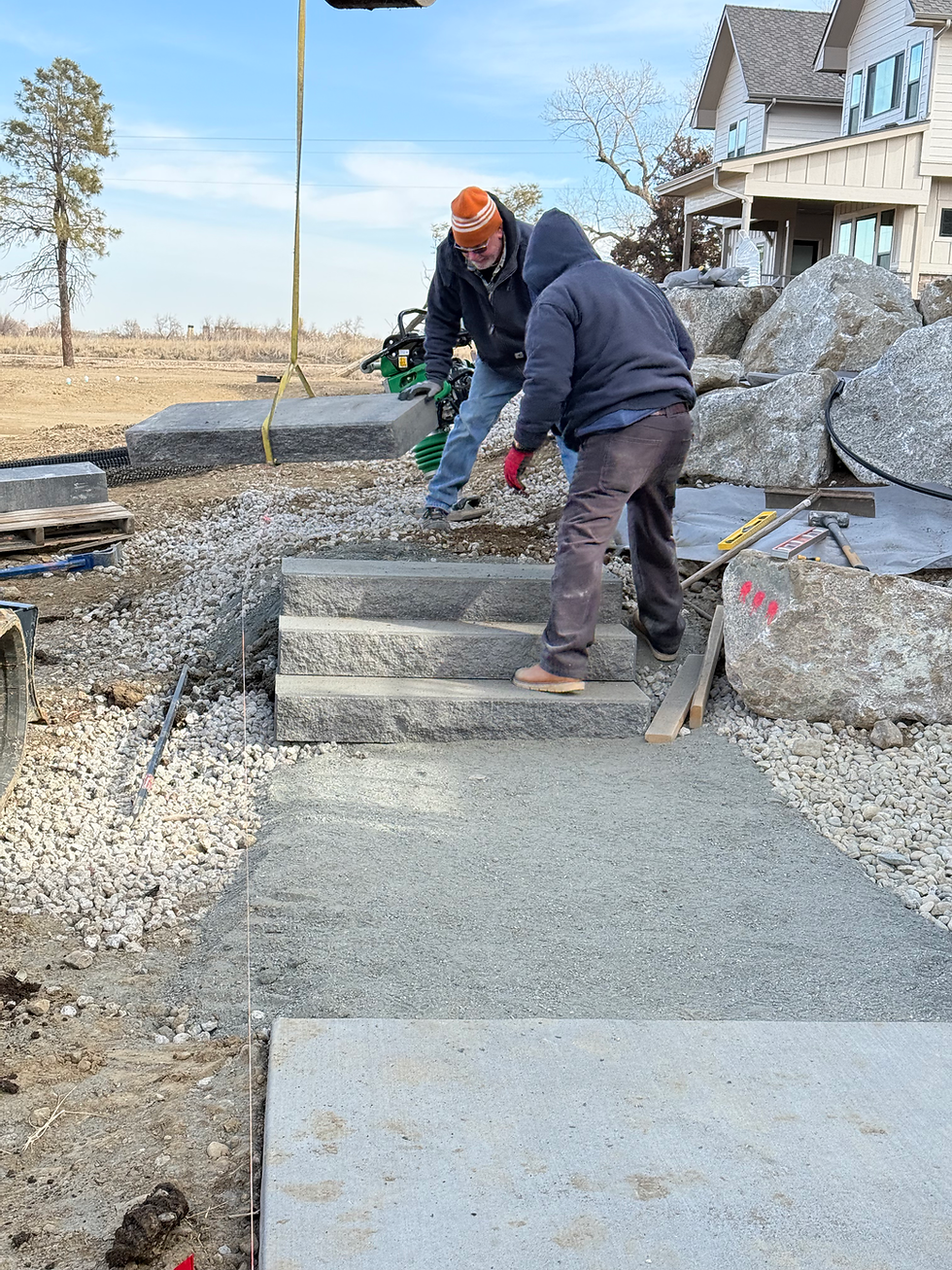
Natural stone — flagstone, quartzite, sandstone, and locally sourced Colorado buff — performs exceptionally well in Boulder's climate when properly installed. Dense, low-absorption stone resists freeze-thaw damage and develops a patina over time that integrates naturally with the surrounding landscape. The critical variable is installation: flagstone set in a compacted gravel base with appropriate joint material will move slightly with freeze-thaw cycles and self-stabilize; flagstone set in a rigid mortar bed without adequate drainage will crack, heave, and require periodic releveling. The base course — typically eight to twelve inches of compacted road base aggregate — is invisible in the finished product but determines the long-term performance of the surface above it.
Concrete pavers offer design flexibility and consistent material properties, with the added advantage of being replaceable as individual units if damage or settling occurs. Permeable paver systems, which incorporate open joints filled with gravel aggregate, reduce stormwater runoff and support Boulder County's water quality goals. For properties with clay-heavy soils prone to surface runoff, permeable hardscape can be a meaningful engineering solution as well as a design choice. Poured concrete is less common in high-end custom builds in Boulder due to its susceptibility to cracking under the region's thermal movement, though properly reinforced and control-jointed concrete can perform well in specific applications.
What Should Homeowners Know About Retaining Walls in Boulder County?
Retaining walls are one of the most consequential structures a homeowner can add to a Boulder County property — and one of the most commonly underbuilt. Any wall retaining more than four feet of soil is a structural element subject to lateral earth pressure, hydrostatic pressure from groundwater, and seismic loading, all of which require engineering analysis to address correctly. Boulder County building codes require permits and engineer-stamped drawings for walls above specified height thresholds, and these requirements exist for good reason.
Boulder's expansive clay soils add a layer of complexity that is specific to this region. Clay soils swell with moisture and contract when dry, exerting lateral pressure against wall faces that fluctuates seasonally. A wall designed only for static soil pressure may perform adequately in its first year but begin to bow, crack, or slide as cumulative seasonal movement accumulates. Proper retaining wall design in Boulder County includes granular backfill behind the wall face to reduce lateral pressure and improve drainage, a continuous drainage aggregate column with perforated pipe at the base to manage hydrostatic pressure, and wall mass or reinforcement designed to resist the full range of expected loading.
From a design perspective, retaining walls in Boulder's landscape are opportunities to create terraced outdoor rooms, introduce planting pockets, and integrate the grade transitions that are common on Front Range properties into a composed spatial sequence. Boulder and lichen-covered fieldstone walls integrate naturally with the regional landscape character; dry-stacked Colorado moss rock or hand-selected granite boulders can create a naturalistic aesthetic that reads as if the geology of the site simply continued upward. These aesthetic decisions have structural implications — dry-stacked walls have lower height limits than mortared or engineered systems — and the best outcomes emerge when design intent and structural requirements are developed together from the start.
What Types of Shade and Shelter Structures Are Right for Boulder Outdoor Spaces?
Overhead structure — pergolas, shade sails, covered patios, and full outdoor rooms — dramatically expands the usability of Boulder outdoor spaces by mitigating the two conditions that most limit comfortable outdoor time: intense midday sun and the afternoon thunderstorms that arrive reliably through July and August. The right structure type depends on the degree of weather protection desired, the architectural character of the home, and the structural constraints of the attachment or foundation points.
Pergolas are the most common custom overhead structure in Boulder landscapes, and they range considerably in engineering quality. A cedar or ipe wood pergola with properly sized rafters and adequate post footings will perform for decades; an undersized structure with insufficient post depth will flex, twist, and potentially fail under the snow loads that even a mid-elevation Boulder property must accommodate. Colorado's Front Range receives periodic heavy, wet snowfall events — sometimes exceeding twelve inches in a single storm — and any permanent overhead structure must be designed to carry this load without deflection. Post footings must extend below the frost line, which in Boulder County is typically thirty-six inches, to prevent seasonal heaving.
Steel and aluminum pergola systems have gained significant market share in recent years due to their durability, dimensional precision, and resistance to the UV degradation that affects wood finishes at Boulder's elevation. Powder-coated aluminum structures require minimal maintenance and hold their finish well under the intense solar radiation of high-altitude sun exposure. For homeowners who want a fully weatherproof outdoor room, louvered roof systems — which allow variable light and ventilation control — are increasingly available in systems engineered for Colorado's snow and wind loads. These structures represent a meaningful investment but can extend comfortable outdoor use by two to three months compared to an open patio.
How Do Fire Features and Outdoor Kitchens Work in Boulder's Environment?
Fire features — fire pits, fire tables, fireplaces, and built-in gas fire elements — are among the most requested custom outdoor builds in Boulder County, and for good reason. The Front Range's cool evenings extend the outdoor season significantly when a heat source is present, and fire creates the social focal point that draws a backyard into active use. The primary considerations for fire feature installation in Boulder County are fuel type, air quality compliance, and structural integration with the surrounding hardscape.
Boulder County and the City of Boulder regulate open burning and wood-burning fire features through air quality ordinances tied to the region's ozone and particulate concerns. Natural gas and propane fire features are not subject to the same burn restrictions as wood-burning fires and are generally the more practical choice for year-round use in the Boulder area. Gas fire elements require a licensed gas line extension from the home's service, properly sized for the BTU demand of the feature, and should be installed with a dedicated shutoff accessible from the immediate area.
Outdoor kitchens represent the most complex category of custom outdoor build from both a design and construction standpoint. A fully equipped outdoor kitchen — with built-in grill, side burners, refrigeration, sink, and counter space — requires coordinated installation of gas lines, electrical service for appliances and lighting, plumbing for the sink drain, and a structural counter system built to withstand Boulder's freeze-thaw cycling without cracking or delaminating. Counter materials in outdoor applications must be specified for frost resistance — porcelain tile and certain natural stones perform well; others will spall within a season or two. The best outdoor kitchens in Boulder are also designed with drainage integrated into the counter slope and surrounding hardscape, preventing water accumulation that accelerates freeze damage.
What Are the Options for Water Features in Boulder Outdoor Spaces?
Water features — from simple boulder fountains to recirculating streams, reflecting pools, and pondless waterfalls — add acoustic and visual complexity to a landscape that is difficult to achieve through planting or hardscape alone. In Boulder's often-dry soundscape, the presence of moving water creates an immediate sense of place. Water features also support wildlife by providing a reliable water source in an urban landscape that lacks natural surface water in most residential settings.
The engineering requirements for water features in Boulder County center on two issues: freeze protection and water loss management. Recirculating systems must be designed with either fully drainable plumbing or submersible pump systems that can be deactivated and drained before hard freeze. Features that retain standing water through winter will sustain freeze damage to pump housings, fittings, and basin liners that accumulates over seasons. Most quality installations in Boulder County include auto-fill valves connected to the irrigation system to compensate for evaporation losses, which can be significant in the region's low-humidity climate.
From a design standpoint, the most successful water features in Boulder landscapes take cues from the regional geology — the boulder-strewn creek corridors of the Front Range foothills provide a natural vocabulary of weathered granite, basalt, and sandstone that translates authentically into residential water feature design. Features built with locally sourced stone and naturalistic grading around the basin edge read as part of the landscape rather than an object placed within it, and they tend to age gracefully as planting establishes around them over successive seasons.
Building for This Place
The outdoor spaces that hold up in Boulder — that look better at year ten than they did at installation, that function through shoulder seasons, that integrate into the landscape rather than sitting on top of it — are the ones that were designed and built with this specific environment in mind. That means material specifications chosen for freeze-thaw performance, structural sizing appropriate for Colorado's snow and wind loads, drainage integrated from the ground up, and a design sensibility rooted in the regional landscape character of the Front Range.
GROW Boulder designs and builds custom outdoor spaces as complete systems — where the engineering decisions support the design intent, and the design intent is grounded in how the space will actually be used and what the site will actually deliver. If you are thinking about what could be built in your Boulder outdoor space, the conversation starts with your site, your lifestyle, and what this environment requires.
Key Takeaways
Custom outdoor builds in Boulder span hardscape, retaining structures, shade and shelter systems, fire features, outdoor kitchens, and water features — each with distinct material requirements and engineering constraints driven by the region's freeze-thaw cycling, expansive soils, and climate.
Hardscape base course preparation — typically eight to twelve inches of compacted aggregate — is the most important determinant of long-term performance; the visible surface material is secondary to what is beneath it.
Retaining walls above four feet in Boulder County require permits and engineer-stamped drawings; expansive clay soils demand granular backfill and continuous drainage systems behind the wall face to manage lateral and hydrostatic pressure.
Pergola and shade structure footings must extend thirty-six inches below grade (Boulder County frost line) and be sized to carry Colorado's wet snow loads, which can exceed twelve inches in a single event.
Gas fire features are the practical choice for year-round use in Boulder County, where air quality ordinances restrict wood-burning fires during high-pollution periods.
Outdoor kitchen counter materials must be specified for frost resistance; porcelain and appropriate natural stones outperform materials that spall under freeze-thaw stress.
Water features in Boulder require freeze-protected plumbing design and auto-fill systems to compensate for evaporation losses in the region's low-humidity climate.
The highest-value outdoor builds integrate design and engineering from the start — with structure, planting, drainage, and hardscape developed as a unified system rather than added sequentially.
Frequently Asked Questions
Do custom outdoor builds require permits in Boulder County?
Most structural outdoor builds — retaining walls above four feet, permanent pergola and shade structures, outdoor kitchens with gas and electrical connections, and any grading work that alters drainage patterns — require permits in Boulder County and most municipalities within it. Always verify permit requirements before beginning construction; unpermitted work creates liability at resale and may require costly removal or remediation.
What is the best patio material for Boulder's freeze-thaw climate?
Dense natural stone (flagstone, quartzite, bluestone) and concrete pavers installed over a properly compacted aggregate base perform best in Boulder's 150-plus annual freeze-thaw cycles. The base course preparation matters as much as the surface material — inadequate base depth is the most common cause of premature hardscape failure in this climate.
How long does a custom outdoor build project take?
Timeline varies significantly by project scope. A patio and pergola installation may take two to four weeks; a comprehensive project including grading, retaining walls, hardscape, water feature, and planting can span two to four months. Permitting timelines in Boulder County add additional lead time that should be factored into project scheduling.
Can outdoor kitchens be used year-round in Boulder?
With proper design — covered structure, infrared heating, weather-resistant materials, and freeze-protected plumbing — outdoor kitchens in Boulder can function comfortably through most of the year. The key is designing for cold-season use from the start, not retrofitting weather protection after the fact.
What maintenance do custom outdoor builds require?
Hardscape requires periodic joint sand replenishment and occasional releveling of settled areas. Wood structures need annual inspection and finish maintenance. Water features require seasonal startup and winterization and periodic pump and filter service. Gas fire features should be inspected annually by a licensed technician. Properly built and maintained, most custom outdoor structures in Boulder have service lives of twenty-five years or more.
How do I integrate custom outdoor builds with existing landscaping?
The most successful integrations happen when outdoor structures and planting are designed together from the start — with planting beds planned to soften hardscape edges, vine structures designed to grow onto pergola rafters, and water features positioned to anchor a composition rather than sit isolated within it. Retrofitting structures into established landscapes is possible but typically requires more compromise.