Engineering for Stability: How Erie's Clay Soils Affect Hardscape Foundations

Erie and Frederick homeowners face "expansive soil" challenges that can ruin a $50k patio in just a few seasons. While a new outdoor living space is a major investment, its longevity depends entirely on what lies beneath the surface. In the northern Front Range piedmont — where plains meet foothills — the ground is not static, but constantly shifting with moisture and temperature.
At GROW Boulder, we approach every project with a combination of design intention and engineered performance. By integrating landscape architecture with sub-base engineering, we create outdoor spaces that remain level, functional, and visually refined for years—despite the challenging soil conditions unique to this region.
What Is the Science Behind Soil Expansion in Erie?
Expansive soils in Erie are driven by clay minerals like smectite, montmorillonite, and bentonite that swell significantly when exposed to moisture. These soils act like a sponge, expanding during spring snowmelt or irrigation and shrinking during dry summer conditions. This constant cycle creates upward pressure, known as heave, which can displace pavers, crack concrete, and destabilize retaining walls.
In practical terms, this means your patio is constantly being pushed and pulled from below. These clays can expand up to 20% by volume and exert forces exceeding 20,000 pounds per square foot. Without proper engineering, even well-installed hardscapes will begin to shift, settle, or fail over time.
This movement is further intensified by freeze-thaw cycles common along the Front Range. When moisture in the soil freezes, it expands and forms ice lenses that push upward. With frost depths reaching around 30 inches in this region, any system not designed to account for both frost and clay expansion is highly vulnerable to long-term damage.
Why Do Traditional Sand-Beds Fail in Northern Colorado?
Traditional sand-set paver systems fail in Erie because they lack the structural strength and drainage capacity needed to resist expansive clay movement. A thin sand layer over minimal gravel does not provide enough separation or stability when the underlying soil shifts. As the clay expands, it pushes unevenly into the sand layer, causing pavers to dip, tilt, and separate.
For homeow
ners, this often shows up as wavy surfaces, loose stones, and pooling water. Sand also retains moisture, which worsens the problem by feeding the expansion cycle below. Instead of acting as a buffer, it becomes part of the instability.
A more reliable system replaces these soft transitions with a fully engineered base. By creating a defined structural layer between native soil and surface materials, we prevent movement from transferring upward into the finished hardscape.
What Is the Engineering Standard for Sub-Base Longevity?

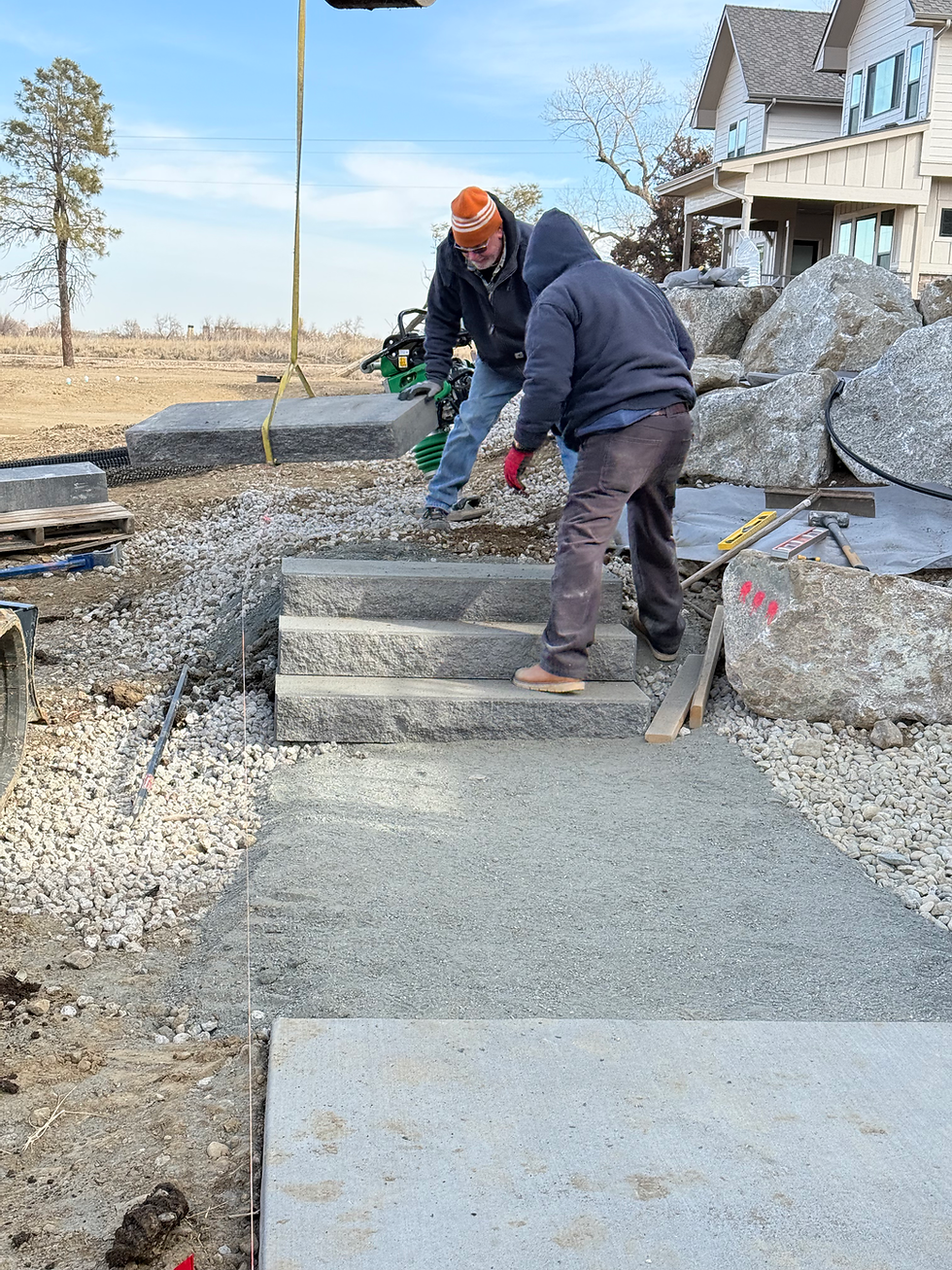
The engineering standard for sub-base longevity in expansive clay soils is a deep-excavation system paired with 8 to 12 inches of compacted, non-expansive aggregate. This approach removes unstable native soil and replaces it with a controlled structural base designed to absorb movement. Th
e exact depth depends on soil conditions, moisture exposure, and the load requirements of the space.
In practical terms, heavier features like outdoor kitchens or fireplaces require deeper and more reinforced bases. This layered system acts as a buffer zone, preventing soil movement from affecting the surface above while maintaining long-term structural integrity.
To preserve this system over time, we install high-strength geotextile fabric between layers. This prevents fine clay particles from migrating into the aggregate base, which would otherwise reduce drainage and compromise performance. The result is a foundation that behaves more like roadway construction than a typical backyard installation.
How Does Proper Drainage Protect Your Hardscape Foundation?
Proper drainage protects your hardscape by controlling the moisture levels that cause clay soil to expand and contract. By directing water away from the patio surface and sub-base, we effectively reduce the soil’s ability to move. This is why we design with a minimum 2% slope, and often closer to 3–5% in high-risk areas.
For homeowners, this means fewer issues with shifting, cracking, or standing water. A dry sub-base is a stable sub-base, and controlling water is the most effective way to achieve that stability.
Beyond surface grading, subsurface drainage systems are often necessary. Perforated pipes surrounded by clean stone intercept groundwater before it reaches the patio, preventing trapped moisture—commonly known as the "bathtub effect." These systems remain invisible but are critical to long-term performance.
How Do Microclimates Influence Material Selection and Performance?
Microclimates directly influence material performance by exposing different areas of your landscape to varying levels of sun, moisture, and temperature stress. South-facing patios experience intense sun and rapid drying, which can lead to thermal expansion and material fatigue. Selecting dense, low-absorption materials helps prevent cracking and fading in these conditions.
From a design standpoint, this ensures the space maintains its visual consistency over time. Materials that perform well structurally also retain their intended color and texture.
North-facing areas, on the other hand, retain moisture and are more susceptible to ice buildup and freeze-thaw damage. These zones require slip-resistant materials and often benefit from deeper sub-base preparation. Designing for these differences ensures the entire landscape performs cohesively, even under varying environmental conditions.
Why Is Soil Compaction the Most Important Step in Construction?
Soil compaction is the most important step because it ensures the sub-base can support weight without settling or shifting over time. By compacting materials in controlled lifts—typically 4 to 8 inches—we eliminate air pockets and create a dense, stable foundation that resists both downward pressure and upward soil movement.
In practical terms, poor compaction leads to uneven settling, which creates low spots or “birdbaths” where water collects. These issues not only affect usability but accelerate long-term damage.
Using proper equipment like vibratory compactors and adhering to strict compaction standards ensures the finished surface remains level and durable. This step may be invisible, but it is the foundation of everything that follows.
Create a Lasting Outdoor Space in Northern Colorado
While the visible elements define how a space looks and feels, the unseen engineering determines how long it lasts.
At GROW Boulder, we believe that design and performance are inseparable. By addressing the challenges of expansive clay soils through proper excavation, drainage, and sub-base construction, we build landscapes that remain stable, functional, and visually compelling for years to come.
Frequently Asked Questions
Can clay soil in Colorado really damage my patio?
Yes, expansive clay soils can cause patios to heave, crack, or settle due to constant moisture-driven movement.
Why is my patio sinking or shifting in Erie?
Patios typically shift due to poor base preparation, inadequate drainage, or expansion and contraction of clay soil beneath the surface.
How deep should a paver base be in Colorado clay soil?
A proper base is typically 8 to 12 inches deep, depending on soil conditions and load requirements.
Key Takeaways
Expansive clay soils in Erie can swell and shrink dramatically, causing structural movement
Proper excavation and base preparation are essential for long-term performance
Drainage is the most effective way to control soil movement
Geotextile separation prevents base contamination and preserves drainage
Compaction in controlled lifts ensures structural stability
Paver systems offer more flexibility than large concrete slabs
Microclimates affect both material choice and performance
Investing in engineering upfront prevents costly repairs later