
Drip vs. Sprinkler Systems: What Works Best in Boulder's Climate

Walk through any established neighborhood in Boulder County and you will see both systems in action — and both failing in predictable ways. Sprinkler heads fogging water into a dry afternoon wind. Drip emitters clogged and undetected, slowly starving the shrubs they were meant to sustain. The question of which irrigation system works best in Boulder's climate is not a simple either-or answer. It depends on what you are watering, where your property sits, and whether the system was designed for this environment or simply installed in it.
Understanding the trade-offs between drip and sprinkler irrigation — and when each is the right tool — allows Boulder County homeowners to make decisions that reduce water use, improve plant health, and lower the long-term cost of landscape maintenance.
How Do Drip and Sprinkler Systems Differ Fundamentally?
Drip irrigation delivers water at low flow rates directly to the root zone of individual plants through emitters, soaker lines, or micro-spray heads positioned close to the soil surface. Because water is applied slowly and targeted to specific locations, very little is lost to evaporation or wind drift — the two most significant sources of inefficiency in overhead irrigation systems. Drip systems typically operate at 1-4 gallons per hour per emitter, which matches the infiltration rate of most soils and eliminates the runoff that faster-applying systems create.
Sprinkler systems — whether conventional spray heads or rotary/rotor systems — apply water through the air column across a coverage area. Spray heads apply water at high rates (1-3 inches per hour), while rotary nozzles apply water more slowly (0.4-0.6 inches per hour) and are significantly more efficient. The fundamental trade-off is coverage uniformity across continuous surfaces versus targeted delivery to individual plants. Sprinklers serve turf effectively; drip serves planting beds effectively — and the distinction matters enormously in Boulder County's water-constrained environment.
Smart controllers can dramatically improve the performance of both system types by adjusting run times based on real-time weather and evapotranspiration data. But the underlying efficiency of the distribution method — how much of the applied water actually reaches plant roots — is determined by the system type itself. Drip consistently delivers more water to root zones per gallon applied than spray, particularly in the low-humidity, high-UV, and frequently windy conditions that define summer afternoons on the Front Range.
Why Does Boulder's Climate Favor Drip Irrigation for Planting Beds?
Boulder County averages relative humidity between 15-25% on summer afternoons — low enough that overhead spray loses a measurable percentage of applied water to evaporation before it reaches the soil surface. Combined with the persistent afternoon winds common along the Front Range, spray systems serving planting beds in this climate routinely deliver 30-50% less water to root zones than their run-time calculations suggest. The result is plants that appear adequately irrigated but are chronically water-stressed.
Wind drift is particularly problematic for small spray heads serving planting beds with irregular geometry. A head designed to throw water eight feet may be delivering most of that water to the wrong location on a typical Boulder afternoon, creating dry spots adjacent to over-watered areas and making it nearly impossible to calibrate run times accurately. Drip systems eliminate this variable entirely — the emitter is at the root zone, and wind has no effect on delivery.
Foliar moisture from overhead irrigation also promotes disease pressure in Boulder County's climate. Powdery mildew, a common fungal issue on roses, squash, and many ornamental plants, thrives when humidity is elevated around the foliage — which is exactly what overhead irrigation creates during the morning hours when most systems run. Drip irrigation keeps foliage dry and reduces the microclimate conditions that support fungal development, resulting in healthier plants with lower chemical intervention requirements.
When Are Sprinkler Systems the Right Choice in Boulder County?
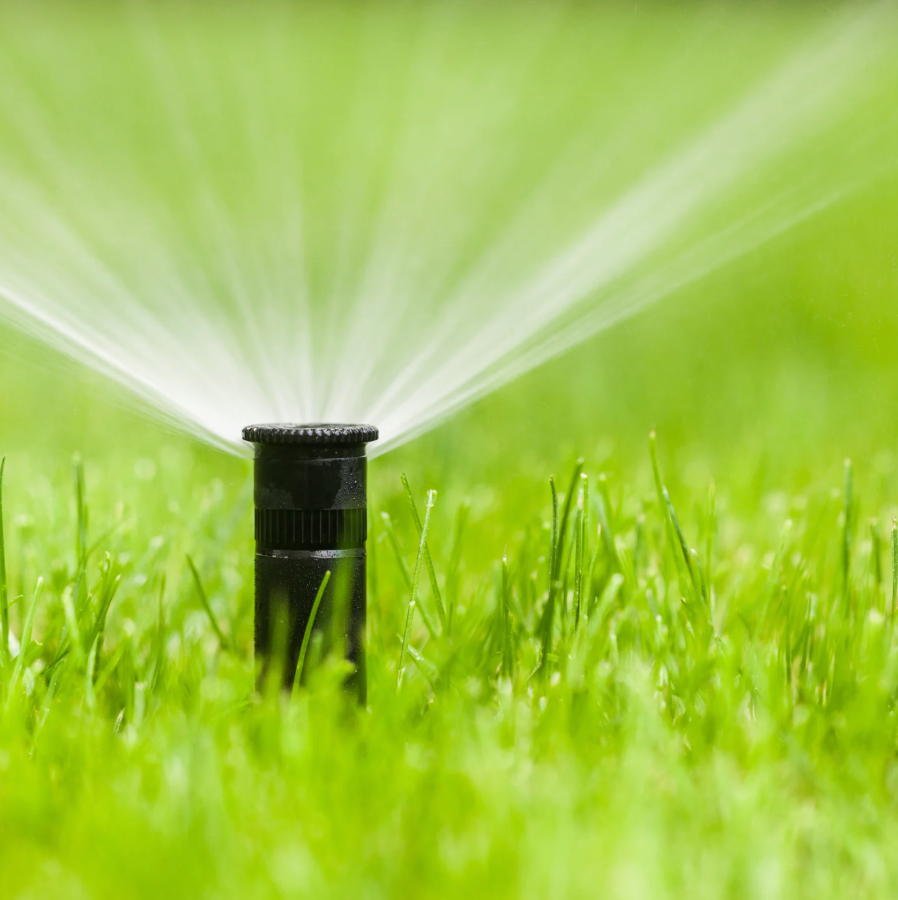
Turf areas require sprinklers — there is no practical alternative for maintaining even moisture across a continuous grass surface. The question for Boulder County homeowners is not whether to use sprinklers on turf, but which type of sprinkler head to specify. Conventional spray heads apply water at rates (1-3 inches per hour) that significantly exceed the infiltration capacity of Boulder's clay-heavy soils, resulting in runoff onto hardscape and sidewalks within minutes of a zone starting. This is not just wasteful — it is a violation of water waste ordinances enforced by many Boulder County water providers.
Rotary nozzles — also called matched-precipitation-rate rotary nozzles or MP rotators — apply water at rates of 0.4-0.6 inches per hour, which aligns with the infiltration capacity of clay soils and eliminates the runoff problem. They also improve distribution uniformity compared to conventional spray and are significantly less affected by wind due to their lower trajectory. For any turf zone in Boulder County, rotary nozzle specification should be considered standard practice, not an upgrade.
Micro-spray heads occupy a middle ground between conventional sprinklers and drip emitters and can be appropriate for groundcover areas, densely planted perennial beds, or native meadow plantings where individual plant targeting is impractical. They apply water at lower rates than conventional spray heads and can be positioned close to the soil surface to minimize evaporation and drift. However, they require more frequent maintenance than drip emitters and are more susceptible to clogging in Boulder County's often mineral-heavy water supply.
What Are the Maintenance Differences Between Drip and Sprinkler Systems?
Drip systems require regular emitter inspection to detect clogging, displacement, or damage — failures that are invisible from the surface and may go undetected until plant stress becomes visible. In Boulder County, mineral deposits from hard water supplies can clog emitters within a single season without proper filtration at the zone valve. Quality drip installations include a filter and pressure regulator at each zone — components that are inexpensive relative to the plant losses they prevent, but frequently omitted in lower-cost installations.
Sprinkler systems are more visibly self-reporting — a broken head, a misaligned rotor, or a zone running outside its intended arc is usually apparent immediately. However, the subtler failures — heads that are applying water at inconsistent rates due to pressure variation, coverage patterns that have drifted from original design as vegetation has grown, or run times that are no longer appropriate for current plant water demand — require a trained eye to detect during a system audit.
Both system types require annual startup in spring and winterization in fall in Boulder County's climate. Drip systems must be inspected for emitter function and filter condition at startup, and lines must be fully purged of water before freeze. Sprinkler systems require compressed air blowout each fall to remove all water from lateral lines, valves, and heads. Skipping winterization on either system type causes cumulative freeze damage that compounds over years and ultimately requires partial or full system replacement.
How Should a Boulder County Property Combine Drip and Sprinkler Systems?
Most residential properties in Boulder County are best served by a hybrid approach that deploys each technology where it performs best. Planting beds, tree rings, vegetable gardens, and native plant areas should be served by drip systems with appropriate emitter type and spacing for the specific plant material. Turf areas — if turf is included in the design at all — should be served by rotary nozzle spray zones with separate programming schedules.
Zoning strategy is critical in a hybrid system. Each plant type — turf, shrubs, perennials, trees — should occupy its own zone or zones, allowing the controller to apply different run times, frequencies, and cycle-and-soak protocols appropriate to each. A tree zone running at the same frequency as a perennial bed will either over-water the perennials or under-water the trees — neither outcome supports a healthy landscape.
Controller programming in a hybrid system should account for the dramatically different precipitation rates between drip and spray zones. A smart controller calibrated to local ET data will calculate appropriate run times differently for a drip zone running at 1 gallon per hour per emitter versus a rotor zone applying 0.5 inches per hour across a turf area. This calibration requires knowledge of the system's hydraulic design — which is why design documentation from the installation phase is essential reference material for programming and future adjustments.
Matching the System to the Site
The best irrigation system for a Boulder County property is not the cheapest, not the most technologically sophisticated, and not the one that matches what your neighbor installed. It is the system designed specifically for your soil type, your plant palette, your property's microclimate, and your water provider's constraints — deployed using the right technology in the right locations, and programmed to respond to what the climate is actually doing rather than a fixed schedule.
GROW Boulder designs irrigation systems as integrated components of landscape performance. When the system is right for the site, it runs efficiently, supports plant health, and reduces the time and cost of ongoing maintenance. If you are evaluating irrigation options for a new install or considering a system upgrade, the design conversation is the right place to start.
Key Takeaways
Drip irrigation consistently outperforms overhead spray for planting beds in Boulder County due to the region's low humidity, frequent afternoon winds, and intense UV — all of which increase evaporation and drift losses from spray systems.
Conventional spray heads apply water at rates that exceed the infiltration capacity of Boulder's clay-heavy soils; rotary nozzles, which apply water at 0.4-0.6 inches per hour, are the appropriate specification for any turf zone in this region.
Overhead irrigation promotes foliar moisture that supports powdery mildew and fungal disease in Boulder County's climate; drip irrigation eliminates this issue by keeping foliage dry.
A hybrid approach — drip for planting beds and rotary nozzle spray for turf — represents the best-practice design for most Boulder County residential properties.
Drip emitter clogging from mineral deposits is common in Boulder County's hard water environment; filter and pressure regulator installation at each zone valve is essential, not optional.
Smart controllers calibrated to local evapotranspiration data improve the performance of both system types and can reduce total water use by 20-30% compared to fixed-schedule programming.
Spray-to-drip conversions for existing planting bed zones are among the most cost-effective irrigation upgrades available in Boulder County, with 30-50% water savings and rebate eligibility through most local water providers.
Both drip and sprinkler systems require annual startup inspection and fall winterization in Boulder County's freeze-thaw climate — the most common cause of premature system failure is deferred or missed winterization.
Frequently Asked Questions
Is drip irrigation better than sprinklers in Boulder County overall?
For planting beds, yes — drip consistently outperforms spray in efficiency, plant health outcomes, and water conservation in Boulder's climate. For turf, sprinklers remain the appropriate choice, with rotary nozzles preferred over conventional spray heads.
How often should drip irrigation run in Boulder County during summer?
Established shrubs and perennials typically need deep, infrequent watering — often two to three times per week during peak summer heat, for longer durations that penetrate to full root depth. Newly planted material requires more frequent, shorter cycles during the establishment period.
Do drip systems work for trees in Boulder County?
Yes, with appropriate emitter placement. Tree rings should use multiple emitters spaced around the drip line of the canopy, not at the trunk. As trees mature and root systems expand, emitter placement should be adjusted outward to follow root development.
How do I know if my drip emitters are clogged?
Check emitters manually at the start of each season by running the zone and verifying flow at each emitter. Pressure gauge testing at zone valves can also identify partial blockages that are not visible at the emitter. Annual filter cleaning prevents most clogging in Boulder County's mineral-heavy water supply.
Can I convert my existing spray system to drip?
In most cases, yes. Planting bed zones can be converted by replacing spray heads with drip zone conversion kits, adding a pressure regulator and filter, and running drip lines to plant locations. This is one of the most cost-effective irrigation upgrades in Boulder County, and many water providers offer rebates for spray-to-drip conversions.
What is the water savings difference between drip and conventional spray?
Studies from Colorado State University Extension and water utilities across the Front Range consistently show 30-50% water savings when converting planting bed irrigation from conventional spray to drip, with the higher savings occurring in exposed, windy sites — which describes much of Boulder County.
Do drip systems require less maintenance than sprinklers?
Not necessarily less — different. Drip systems require more proactive inspection for invisible failures (clogged emitters, disconnected lines) but are less susceptible to the mechanical damage that affects spray heads in high-traffic areas. Both system types require equivalent seasonal care.


